

- By Prof. Okey Nwabuko
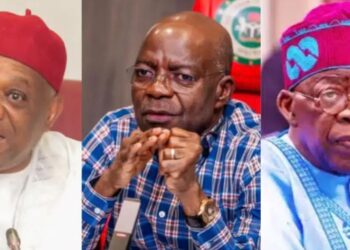
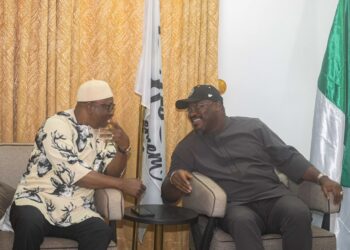
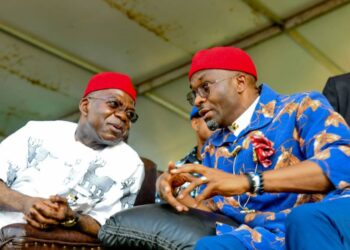
When Governor Alex Otti hosted the lawmaker representing Abia North Senatorial District and former Abia State Governor, Orji Uzor Kalu, he made a statement that caught public attention. He said his mother does not joke with Senator Orji Uzor Kalu. He also openly admitted that he is following Kalu’s template on road construction.
That statement was clear and on record. Words like these are not spoken lightly by a sitting governor. They carry meaning and consequences. It is therefore troubling that, shortly after, aides of Governor Otti began to insult the same Senator Orji Uzor Kalu. This behaviour is not only contradictory; it is an insult to the governor’s own words, to his mother, and to the sensibility of Abians.
We no longer live in an era where statements can be denied or history conveniently altered. Records exist, and people remember. Governor Otti’s growing anxiety about the 2027 election appears to be pushing him towards an imperial posture, where a different political ideology is treated as hostility and criticism as treachery.
Even more disturbing is the sudden confusion about identity. Alex Otti, long known as an Aro man, now presents himself as an Ngwa man for political convenience. Governor Otti must understand that Identity is not a campaign slogan. It is not something to be adjusted to suit ambition. One must ask plainly: where is the conscience?
Politics is not only about winning elections. It is about trust and responsibility. Governor Otti should honestly reflect on the promises he made to those who supported him. Have those promises been kept? How were those supporters treated after victory? History shows that leaders who forget their base often face rejection when the tide turns.
It is also important to remind Abians that governance in the state did not begin in 2023. Between 1999 and 2007, Dr Orji Uzor Kalu governed Abia State under severe financial and structural constraints. He inherited a state weighed down by unpaid salaries, pension arrears, decayed infrastructure and insecurity. Yet, within months, workers’ salary arrears were cleared and a system of regular payment was established, with salaries paid consistently.
Abia also inherited a heavy debt burden, including a foreign loan of about 680 million dollars incurred for projects such as Enyimba Hotel, the Glass Industry in Aba, Ogwe Chicken Farm and the Metallurgical Factory in Olokoro. Despite this strain, Abia was compelled to service these debts during Kalu’s tenure. The former Minister of Finance, Dr Ngozi Okonjo-Iweala, is on record to confirm these facts.
Road construction was a major focus of that administration. Aba, which was close to collapse in 1999, witnessed extensive reconstruction, beginning with five major roads financed through a ₦500 million facility raised from Guaranty Trust Bank under the leadership of the late Tayo Aderinokun. By February 2000, these roads were ready for commissioning by President Olusegun Obasanjo, who publicly described Kalu as the “Action Governor of Nigeria”.
Beyond these early projects, all major roads in Umuahia were already tarred before 2007. These included roads in Government Station Layout, Aguiyi-Ironsi Layout, Ehimiri Housing Estate, and areas around the State House of Assembly. In Aba, roads such as Cameroun Road, Ojike Lane, Ehere, Umuola and All Saints’ Academy Road were completed. Massive rural roads were also constructed across Ukwa East, Ohafia, Ikwuano, Isiala Ngwa, Obingwa, Umunneochi and Igbere, many of them built with 70mm asphalt, a very high standard by any measure.
Security was another defining achievement. Throughout those eight years, Abia State recorded no cases of kidnapping or political killings. Over 3,000 policemen posted to the state were insured, and when a policeman died on duty, his family was immediately paid ₦10 million. This policy boosted morale and made Abia one of the safest states in Nigeria at the time.
Education also received focused attention. When Kalu assumed office, more than 1,250 schools were dilapidated, many without roofs or desks. Working with the Education Tax Fund (ETF), his administration renovated 821 schools, built 524 new classrooms, supplied over 155,000 desks and benches, and sustained tuition-free education in public primary schools. Tertiary institutions, including Abia State University, Uturu, received regular subventions, hostels, buses, generators and facility upgrades for accreditation.
These achievements were not self-assessed. In 2002, a Federal Government Media Assessment Tour led by Chief Smart Adeyemi, then President of the Nigeria Union of Journalists, evaluated projects across the country. Abia State ranked second overall, scoring strongly across education, health, urban and rural roads, water supply, housing, crime control and sports, despite receiving only ₦15.4 billion from the federation account.
This is not an attempt to portray anyone as flawless. Every administration has its weaknesses. But honesty demands respect for history. You cannot praise a man publicly, borrow his template, and then allow your aides to abuse him without appearing hypocritical.
Governor Otti must slow down, reflect and recalibrate. Leadership is not arrogance. It is restraint, humility and respect for those who came before you.
Abians are watching. They are listening. And when 2027 comes, they will remember.
Professor Okey Nwabuko writes from Maryland, USA.