

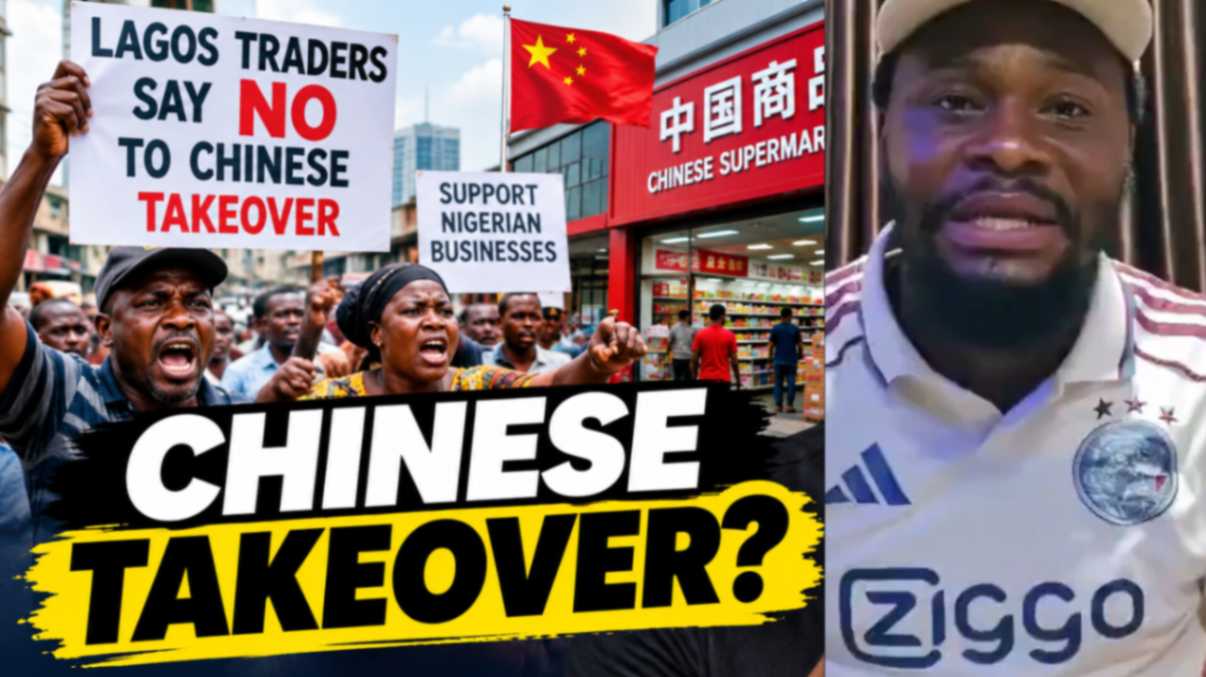
A trader who participated in the controversial “Chinese Must Go” protest at the Lagos International Trade Fair Complex has explained why Nigerian traders took to the streets, insisting that their complaint is about competition in the retail market and not hostility towards Chinese nationals.

The protest, which took place at the Lagos International Trade Fair Complex along the Lagos-Badagry Expressway, attracted attention after videos showed traders carrying placards with inscriptions including “Chinese must go” and “They should go far from our market environment and not be taking our customers.”
The protesters alleged that some Chinese manufacturers and wholesalers operating within the complex had expanded into retail trading, putting them in direct competition with Nigerian traders.
In a video from the protest, one of the traders explained that the relationship between Nigerian traders and Chinese businesspeople had traditionally been beneficial, but argued that problems had emerged because some Chinese businesses were allegedly moving into the retail space.
“What we are saying is that the personal relationship between us and the Chinese is important to us, but they should not do our business,” the trader said.
According to him, Chinese businesses that initially came into Nigeria as manufacturers or wholesalers were now allegedly renting shops, establishing warehouses and selling directly to consumers.
He claimed that the development was affecting the ability of Nigerian retailers to make sales because Chinese businesses could offer products at prices local traders found difficult to match.
“They came and built warehouses, rented shops and are now selling as we do as retailers,” he alleged.
The trader further alleged that some Chinese businesses obtain customers’ contact details from waybills and subsequently contact those customers directly to sell their products.
“If we send a waybill, they copy the customer’s number. We no longer make sales,” he claimed.
He also warned that the situation could have long-term consequences for Nigerian traders if it continued unchecked.
“If this continues, five years from now, your shop will be taken away from you,” he warned.
‘We Are Not Saying They Should Be Attacked’
The trader also sought to distinguish the protest from calls for violence or destruction of Chinese-owned businesses.
He said the protesters respected the relationship between Nigeria and China but wanted the authorities to address what they described as unfair competition in the retail market.
“We respect China. China is a good country. You accommodate our people, and we accommodate you too,” he said, while calling on Chinese businesses to respect the existing trading arrangement.
The comments came amid growing debate over the role of foreign-owned businesses in Nigeria’s retail sector and the ability of local traders to compete with businesses that have direct access to manufacturers and international supply chains.
Traders Association Intervenes
The protest was subsequently suspended following intervention by the leadership of the Traders Association, local government officials and the police.
The Secretary of the Traders Association at the complex, Juventus Okpala-Okaka, said the association had received complaints from youths over the activities of Chinese merchants and had already constituted a committee to examine the matter.
He said representatives of the protesters later met with the association’s executives and committee members, with the discussions making progress towards resolving the dispute.
According to him, local government officials and the police area commander also visited the complex and were briefed on the steps already taken by the market leadership.
The intervention came as the controversy continued to generate reactions online, with some Nigerians calling for government intervention while others argued that consumers benefit from lower prices offered by competing businesses.
For the protesting traders, however, the central issue remains the alleged entry of Chinese manufacturers and wholesalers into retail trading and the impact they say it is having on Nigerian-owned businesses.
The dispute has therefore opened a wider conversation about competition, foreign participation in Nigeria’s retail market, consumer prices and the future of local traders.